Why KS2 writing stays low, and why spelling is often the real bottleneck
Writing is the lowest-attaining of the three core subjects at the end of primary, and it has been for years. When a school's writing data is stubbornly low, the instinct is to reach for a writing intervention. Before you do, it is worth checking what is actually holding your lowest writers back, because for a lot of them the limiter is not ideas. It is transcription: the spelling and handwriting that should be automatic by now and are not.
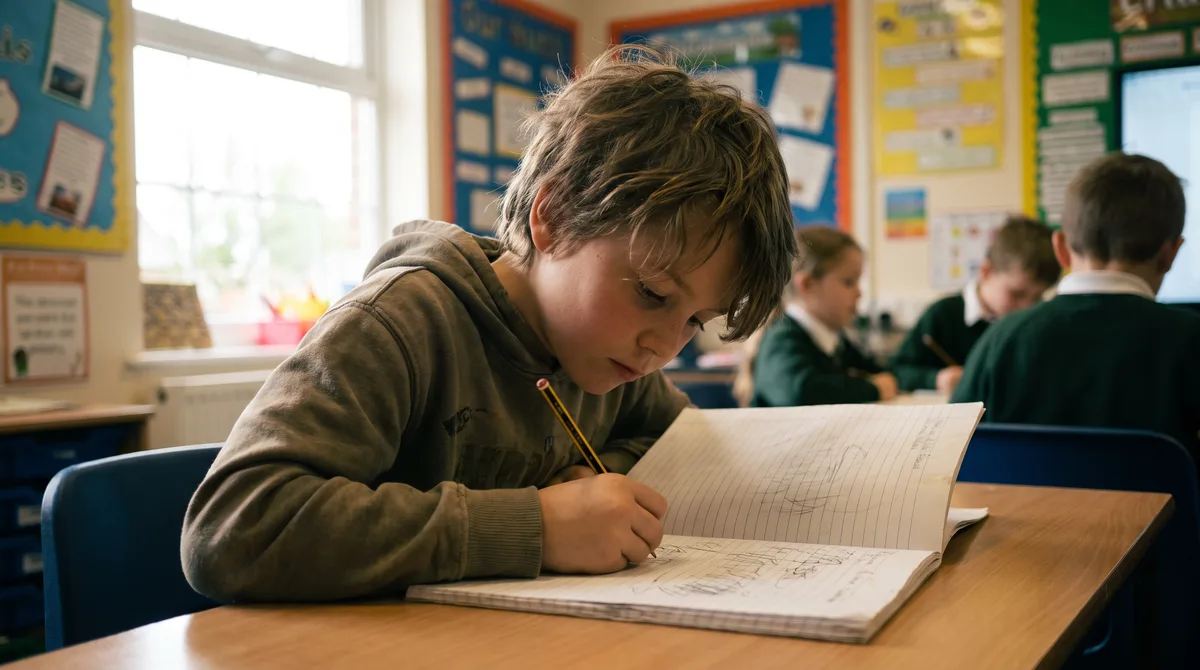
Why is writing so much lower than reading and maths?
At the end of Key Stage 2 in 2024-25, 72% of pupils met the expected standard in writing, against 75% in reading and 74% in maths. Writing has trailed the other two core subjects for years, and it has not recovered to the 78% reached in 2019. One honest caveat: writing is teacher-assessed rather than tested, so it carries more moderation variation than reading or maths. Even so, the gap is consistent and real.
When that data lands, the natural move is to buy a writing scheme. Sometimes that is right. But for a large share of the pupils dragging the figure down, the problem is not that they have nothing to say. It is that the mechanics of getting words onto the page, spelling above all, are still costing them too much effort. Transcription is one cause among several, alongside language, vocabulary and the difficulty of moderation, but it is the one most often missed, because the child's ideas look fine the moment someone else holds the pen.
What the Simple View of Writing says
Writing breaks down into two jobs: transcription and composition. Transcription is the secretarial work, spelling and handwriting. Composition is the authorial work, generating ideas, choosing words, building sentences. This transcription-and-composition split, often called the Simple View of Writing, is the model the DfE's 2025 Writing Framework is built on. As the framework puts it, just as decoding is not reading, transcription is not writing: it is essential but not sufficient.
The later refinement, sometimes called the not-so-simple view, adds a third element: the working memory and self-regulation that have to hold transcription and composition together at the same time. That third element is where struggling KS2 writers most often come unstuck, and it explains why spelling matters so much more to writing than it first appears.
Why non-automatic spelling holds writing back
Working memory is limited, and writing asks a lot of it at once: hold the idea, choose the word, build the sentence, spell each word, form each letter, remember the plan. When spelling is automatic, it runs in the background and leaves that capacity free for the ideas. When it is not, every uncertain word pulls attention away from composition.
This is not a fringe claim. The DfE's 2025 Writing Framework states it plainly: the more we have to think about transcription, the less working memory is available for our compositions. Ofsted's English research review makes the same point, noting that stopping to think about spelling a word uses working memory needed for other aspects of writing, so pupils may forget the ideas or plans they were holding in their heads. A child who can spell without thinking simply has more of their mind available for what they actually want to say. We unpack the memory science behind automaticity in how children actually learn to spell.
Free up working memory for writing
SpellCast builds spelling automaticity with the statutory lists, retrieval and spaced practice, so less of your pupils' attention goes on spelling and more on what they want to say. Free for your whole class, set up in two minutes, no card needed.
Spelling is not the whole story
It would be convenient to claim that fixing spelling fixes writing. The evidence does not support that, and saying so would be dishonest. Reviews of the research find that teaching transcription on its own does not reliably raise composition, and for some fluent older writers the knock-on effect of spelling on text quality is modest. Transcription is a bottleneck, not the engine.
So spelling automaticity is necessary, not sufficient. A child also needs things to write about, the vocabulary to write them with, models of good sentences, and a lot of actual writing. The point is narrower and still important: if transcription is not fluent, all of that good teaching has less room to land, because the pupil's attention keeps getting pulled back to the spelling.
How to tell if transcription is the bottleneck
There is a quick classroom check. Take a piece of writing the pupil produces independently, then take a second piece on a similar task where they dictate and you scribe, removing the transcription demand entirely. Keep the two tasks comparable in genre and topic, or the difference may reflect the task rather than the transcription load. If the scribed version jumps in vocabulary, sentence variety and ideas, transcription is very likely limiting what they can show you on their own.
Treat this as a practical heuristic, not a formal test. It has no standardised cut-score, but it follows directly from the working-memory model, and it tells you something a writing scheme will not: whether your intervention should target composition, or whether it should first make the spelling and handwriting cheap enough that composition has somewhere to go.
What to do about it
If transcription is the limiter, the fix is automaticity, built the way the evidence says spelling sticks: short, regular, retrieval-based practice rather than copying, with words brought back across days rather than crammed before a Friday test. The Education Endowment Foundation's Key Stage 2 literacy guidance puts transcription and sentence construction front and centre, and the DfE framework recommends weekly dictation for exactly this reason, because writing a word inside a spoken sentence is closer to the real task than copying it from a list.
Ofsted's 2024 English subject report notes, among other findings, that primary pupils are often set complex writing tasks before they have the fluency to manage them. Securing the basics first is not a lowering of ambition. It is what makes the ambition reachable.
The same logic applies to handwriting fluency. This piece focuses on spelling because that is where the statutory curriculum gives the clearest progression to build on, not because handwriting matters less.
This is the part SpellCast is built for. It is not a writing scheme and does not pretend to be. It takes the spelling-automaticity job, the statutory Year 3/4 and Year 5/6 lists with the morphology surfaced, every word read inside an example sentence, practised through retrieval and spaced across days so it becomes automatic. It runs alongside your writing curriculum and your phonics scheme, and schools can try it free across the whole class. For where spelling fits relative to phonics, see phonics schemes and spelling.
The short version
Writing is the lowest core subject because it is the hardest: it asks a child to be author and secretary at once, on a fixed budget of working memory. For your strongest writers, transcription is already cheap and the budget goes to ideas. For your strugglers, spelling and handwriting eat the budget and the ideas suffer. Before you buy a writing scheme, scribe a piece and see what a pupil can do when the transcription cost is removed. If the difference is large, make spelling automatic first. The ideas were there all along.
Sources
- Department for Education (2025). The Writing Framework (non-statutory guidance).
- Department for Education (2025). Key Stage 2 attainment, national headlines 2024-25.
- Berninger, V. W. & Winn, W. (2006). Implications of advancements in brain research for writing development. Handbook of Writing Research.
- McCutchen, D. (1996). A capacity theory of writing: working memory in composition. Educational Psychology Review, 8.
- Ofsted (2022). Curriculum research review series: English. And Ofsted (2024). Telling the story: the English education subject report.
- Kim, Y-S. G. et al. (2021). Writing instruction in the primary grades: a meta-analysis. Educational Research Review.
- Education Endowment Foundation (2021). Improving Literacy in Key Stage 2 (second edition).
Frequently asked questions
Why is KS2 writing lower than reading and maths?
What is the Simple View of Writing?
Does improving spelling improve writing?
How can I tell if spelling is holding a pupil's writing back?
How should KS2 spelling be practised to support writing?
Free KS2 spelling practice for your class
SpellCast builds spelling automaticity with the statutory Year 3/4 and Year 5/6 lists, retrieval and spaced practice. It sits alongside your writing curriculum. Sign your class up free: no card, no pupil names to upload.